Case study · India
 India
IndiaCampus management system for schools, hostels, gurukuls, and trusts
Designed and built DigiCampus, a campus management system for ashrams and trusts: fourteen connected modules on one directory of people, from dining and guest houses to donations and event bookings, shipped as an Angular and Supabase web app now running in production.
Live pages
 Live pages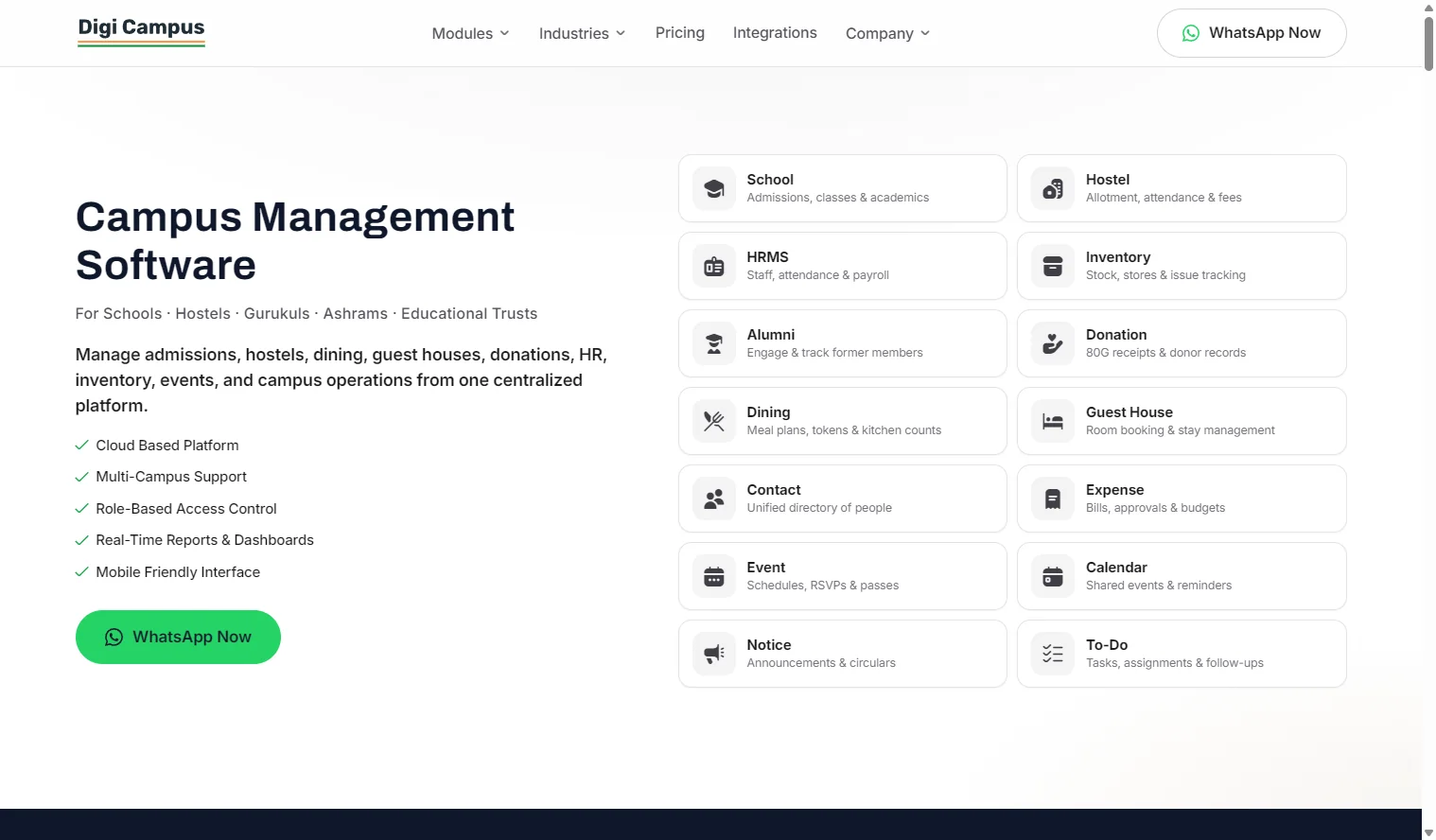
Role
Product Designer & Builder Role
RoleScope
Angular · Supabase · 14 modules · In production Scope
ScopeTools
Figma, Angular, PrimeNG, Tailwind CSS, Supabase Tools
Tools01 Context
Who, why, and what 01 Context
Ashrams, gurukuls, and trusts run dining, guest houses, hostels, donations, schools, and events on separate registers and apps that never talk to each other.
Designed forCampus administrators, kitchen and guest-house staff, accountants, and devotees and guests booking through public forms
02 Problem
What needed to change 02 Problem
Every department keeps its own list of the same people, so a guest checking in, a donor giving at the counter, or a function being fixed has to be typed in again somewhere else.
03 Approach
What I did 03 Approach
I designed the system around one shared directory of people and campuses, so each module reads and writes the same records instead of keeping its own copy.
- Modelled the campus as a shared directory of people and places across every module.
- Built the app in Angular with PrimeNG and Tailwind on Supabase, using staged data before releases.
- Designed a public event booking flow with NRI stays and room allocation alongside the product launch materials.
04 Solution
What shipped 04 Solution
A multi-campus web app where fourteen modules share the same people and data: dining with meal counts and kitchen purchase orders, guest house bed maps, donations with 80G receipts, event bookings with room allocation, and Telegram notifications when something changes.
Live in production with a public event-booking flow, staged releases, and launch materials including a brochure, highlights deck, and 56-post social pack.
05 Reflection
What stayed with me 05 Reflection